How Suboxone Treatment Actually Works — And What Starting It Really Involves
Most people who ask about Suboxone have already decided they want out. That is not usually the hard part.
The hard part is that almost everything they have heard about it is either wrong, secondhand, or fifteen years out of date. So before you call anyone, here is a straight explanation of what buprenorphine does, what it does not do, and where the honest uncertainty still is.
Where Utah actually stands
In the twelve months ending June 30, 2025, Utah recorded 576 drug overdose deaths. Of those, 393 involved opioids and 227 involved fentanyl specifically.
That is down 9.4% from the 636 deaths in the prior twelve months, and the opioid death rate is now statistically significantly lower than it was. That is real progress, and it is worth naming.
Two things keep it from being the whole picture.
Salt Lake County carries roughly half the state’s total — 296 deaths, at a rate of 24.0 per 100,000 residents, consistently the highest in Utah. If you live in Salt Lake City, West Valley, Murray, or Taylorsville, you are in the part of the state where this is hitting hardest.
And this is not only an opioid problem. In that same period, methamphetamine was involved in more Utah overdose deaths than any other single substance. More than 90% of fatal overdoses in the state involved an opioid, a stimulant, or both — very often together. If you are using both, a plan that only addresses the opioid side is an incomplete plan. Say so when you call, because it changes what treatment should look like.
(These are preliminary medical examiner figures and get revised. Treat them as the shape of the problem, not the final count.)
Here is the finding that should bother you most. Among 17,568 Massachusetts adults who survived an opioid overdose, fewer than one in three received any medication for opioid use disorder in the following year. Only 17% got buprenorphine. Those who did had a 38% lower rate of opioid-related death over the following year.
That is an observational study, not a controlled trial, so it shows a strong association rather than proof of cause. But the size of the gap is hard to explain away, and the access problem it describes is not subtle.
What Suboxone actually is
Suboxone is two drugs in one film or tablet: buprenorphine and naloxone.
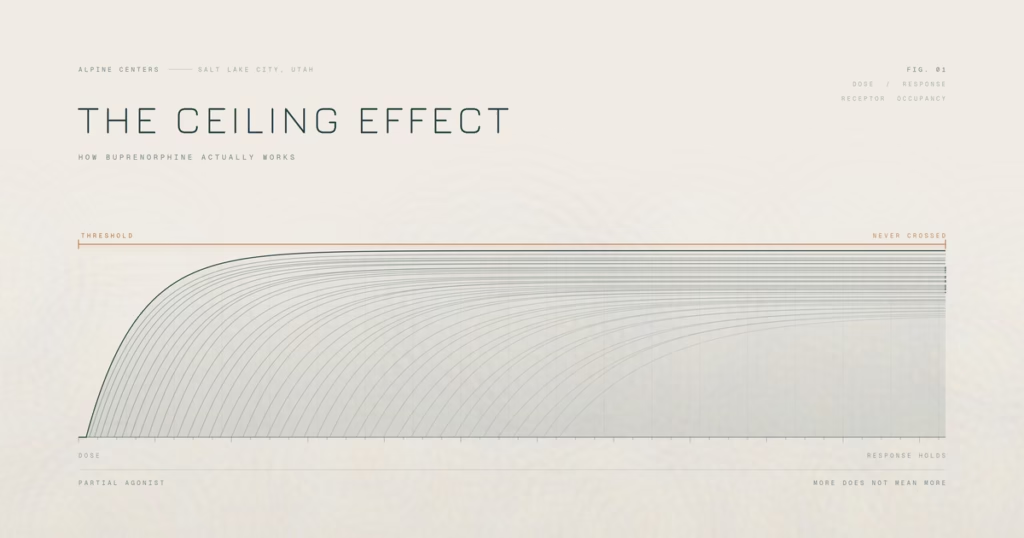
Buprenorphine is the part that does the work. It is a partial opioid agonist, which is the single most important thing to understand about it. It attaches to the same receptors as heroin, oxycodone, and fentanyl — but it only activates them partway, and it has what pharmacologists call a ceiling effect. Past a certain dose, the respiratory depression and the subjective “high” stop increasing no matter how much more you take. That plateau is why buprenorphine is far harder to overdose on than a full agonist.
One serious caveat, because it is the caveat that actually kills people: the ceiling does not protect you from combining it with benzodiazepines or alcohol. Nearly all fatal buprenorphine poisonings involve those combinations. If you are taking Xanax, Klonopin, or drinking, your prescriber needs to know before you start, not after.
Buprenorphine also binds tightly — it has a very high affinity for the opioid receptor and outcompetes other opioids for the seat. This is why cravings quiet down and why using on top of it does much less than people expect.
Naloxone is the second ingredient. Taken as prescribed, dissolved under the tongue, it is barely absorbed and contributes very little. It was added on the theory that injecting the film would trigger withdrawal and deter misuse. Whether it works that way in practice is debated in the literature. Think of it as a design intention rather than a guarantee.
What it feels like — the question nobody asks out loud
Patients rarely ask this directly, so we will answer it anyway: for someone with an established opioid tolerance, a properly managed dose of buprenorphine does not produce a high.
What it does is remove the withdrawal and quiet the craving, and then it stops. There is no rush and no nod. For someone whose entire day has been organized around avoiding withdrawal, the first accurate description is usually some version of nothing happened, and that was the point. You feel normal. You are able to think about something else.
That flatness is not a side effect. It is the medication working correctly.
Precipitated withdrawal: what is real, and what is still argued about
This is the part people are most afraid of, and it deserves an honest answer rather than a confident one.
Because buprenorphine binds so tightly, taking it while other opioids still occupy your receptors can displace them — swapping strong activation for partial activation. The body reads that drop as sudden, severe withdrawal. It is called precipitated withdrawal, and it is worse than the withdrawal the person was trying to escape. This risk is real and it is why induction is timed rather than immediate.
The standard approach is to wait until you are already in mild-to-moderate withdrawal, then start. That protocol remains the most studied one, and current national guidance still recommends it for most people — including most people using fentanyl.
Where it gets genuinely contested is what fentanyl changes. Fentanyl is highly fat-soluble, so with heavy repeated use it accumulates in body tissue and clears more slowly and less predictably than its half-life suggests; metabolites can remain detectable for weeks. That is well documented. What is not settled is whether this actually makes precipitated withdrawal meaningfully more common. Some clinicians report that it does. Recent guidance from the Providers Clinical Support System notes that the evidence for that belief is currently lacking, and several studies have found low rates of precipitated withdrawal using standard initiation even in fentanyl users.
Low-dose initiation — sometimes called micro-dosing, starting with very small amounts and increasing gradually — exists as an alternative in some specialty settings. It is promising and it is not yet backed by strong comparative evidence.
Two practical conclusions hold regardless of how that debate resolves:
Timing and protocol are a prescriber’s call, not a guess to make with someone else’s prescription. What is right depends on what you have been using, how much, and how recently.
If a previous attempt at Suboxone went badly, that is not a verdict on the medication. It is one of the most common reasons people refuse to try again, and it is very often a timing problem that a prescriber who works with fentanyl regularly can solve.
Suboxone vs. Sublocade: daily film or monthly shot
Both are buprenorphine. The difference is delivery.
Suboxone is taken daily under the tongue. It is flexible, adjusts quickly, and costs less up front. It also requires remembering it every single day and keeping it somewhere secure — which, in early recovery or an unstable living situation, is a real variable.
Sublocade is a once-monthly injection given in the office. It holds steady blood levels, removes the daily decision, and cannot be lost, stolen, or taken by someone else. It is not a starting point: its labeling calls for about a week of daily buprenorphine first to establish tolerance and a stable dose. So the usual sequence is film first, then a switch to the injection if the daily routine is the thing tripping you up.
Neither is the advanced version of the other. They solve different problems.
“Isn’t this just trading one addiction for another?”
This objection deserves a real answer rather than a dismissal, because it is usually asked in good faith — often by a parent or spouse who has watched someone lie about pills for years and is not inclined to trust a new one.
The distinction is between dependence and addiction. Dependence means your body has adapted to a substance and will experience withdrawal without it. That is also true of insulin, blood pressure medication, and SSRIs. Addiction is a behavioral disorder: compulsive use, loss of control, continued use despite escalating harm to your job, your health, and the people around you.
Someone stable on buprenorphine is physically dependent. They are also working, showing up, not seeking, not stealing, and not overdosing. The medication does not produce euphoria at a stable dose, does not require escalating doses, and does not consume the day. Those are not the features of an addiction — that is what treated illness looks like.
Dosing and duration, honestly
Dose matters, and underdosing is a real and underappreciated problem. Effective doses are typically 16 to 32 mg per day, titrated up quickly enough to fully suppress cravings and withdrawal. A 2023 analysis of 6,499 patients in Rhode Island compared 16 mg to 24 mg and found the 16 mg group was significantly more likely to drop out of treatment within six months. In the fentanyl era, 16 mg increasingly looks like a floor rather than a target. A dose that only partly controls cravings is not a cautious dose. It is an ineffective one, and it is worth raising with your prescriber if that is where you are.
Longer is better. Clinical guidance is to continue buprenorphine for at least one year, and indefinitely as long as it remains beneficial. Be aware that dropout is common and heavily concentrated in the first six months — which is an argument for staying engaged through that window, not for tapering out of it. Relapse rates rise sharply with early discontinuation. The instinct to get off it as fast as possible is understandable and it is not supported by the evidence.
If and when tapering makes sense, it is a slow, deliberate process built around your stability — not a deadline set in the first month.
Where therapy fits — and where it doesn’t
Here is something most treatment centers will not tell you: counseling should never be a gate you have to pass to get medication. Randomized trials have found that adding routine drug counseling to well-managed buprenorphine does not reliably improve opioid outcomes, and federal guidance was revised specifically because counseling mandates were functioning as an access barrier. If a program will not prescribe until you complete something, that is a policy choice, not an evidence-based one.
What therapy is genuinely for is everything the medication does not touch. Buprenorphine handles the neurochemistry. It does nothing about untreated PTSD, depression, anxiety, or ADHD — and co-occurring conditions are the norm here rather than the exception. It does nothing about stimulant use, which as noted above is now involved in a large share of Utah overdose deaths. Leaving those untreated is how people end up back where they started.
So the useful question is not “do I also need therapy.” It is “what else am I actually dealing with, and is anyone treating it?” If the answer is a co-occurring condition or concurrent stimulant use, a structured outpatient program gives you several sessions a week while you keep working and living at home. If the answer is nothing else, medication and monitoring may be enough, and you should not be forced into more.
What treatment actually looks like week to week
A functioning MAT program is not a prescription and a handshake.
It starts with an evaluation of what you have been using, how much, how long, and what else is going on. From there: an induction plan matched to your actual drug use, frequent contact in the first weeks while the dose is dialed in, then longer intervals as things stabilize.
One practical note: since federal rules changed at the end of 2022, the old “X-waiver” is gone. Any DEA-registered prescriber can now prescribe buprenorphine, and patient caps were eliminated. The bottleneck is no longer regulatory — it is finding a provider who will actually take you quickly.
What it costs
Buprenorphine is covered by Utah Medicaid and by most major commercial plans, including SelectHealth, Regence BlueCross BlueShield, United Healthcare, Aetna, Cigna, PEHP, and TRICARE. Generic buprenorphine/naloxone is inexpensive. Sublocade is billed as a medical injection and commonly requires prior authorization.
Coverage terms, formulary tiers, and authorization requirements vary by plan, so verify your specific benefits rather than assuming. Cost is usually a smaller barrier than people expect.
Frequently asked questions
How long does it take Suboxone to start working? Most people notice withdrawal symptoms easing within the first hour or two of a properly timed dose. Finding a stable dose usually takes several days to a week, and sometimes longer.
Can I start Suboxone if I’ve been using fentanyl? Yes. Most people using fentanyl start successfully on the standard protocol, timed to begin once withdrawal has set in. Some prescribers use a low-dose gradual approach instead. Which is right for you depends on your specific use pattern, and it is a decision to make with a prescriber rather than on your own.
Will I fail a drug test on Suboxone? Buprenorphine does not trigger a standard opiate immunoassay — those detect morphine and codeine derivatives. It shows up only on a test that screens for it specifically. If you are in a monitoring program, a court program, or a safety-sensitive job, disclose your prescription up front.
Do I have to detox before starting? No, and requiring it is outdated and dangerous. Tolerance drops fast during withdrawal management, and the period right after detox is precisely when overdose risk spikes. Buprenorphine is started during early withdrawal, not after full detox.
Can I take Suboxone long-term? Yes. Guidance supports continuing it for at least a year and indefinitely as long as it is helping. There is no medical requirement to stop.
Does Suboxone treat depression or anxiety? No. It treats opioid use disorder. If you also have a mental health condition, it needs its own treatment — ideally from the same team, so the two plans are not working against each other.
What if I’m using meth too? Tell your provider. There is no equivalent medication for stimulant use disorder, so the plan has to be built differently — and given how often the two appear together in Utah overdose deaths, this is not an edge case.
If you are somewhere in this
The gap between deciding to stop and actually starting is where most of the damage happens. It is measured in days, and the risk is not evenly distributed across them.
Alpine Centers provides Suboxone and Sublocade treatment, outpatient detox, IOP, and psychiatric medication management in Taylorsville, serving Salt Lake City, West Valley City, Murray, West Jordan, Sandy, South Jordan, Draper, and Midvale. Medicaid and most major insurance accepted.
Call (801) 268-1715 for a free, confidential consultation, or schedule online.
If you have tried this before and it did not hold, that is a reason to call, not a reason not to.
This article is for general education and is not medical advice. Buprenorphine treatment should be started and managed by a qualified prescriber, and individual results vary. If you or someone else may be experiencing an overdose, call 911 immediately. The 988 Suicide & Crisis Lifeline is available 24/7 by call or text at 988.
Sources