
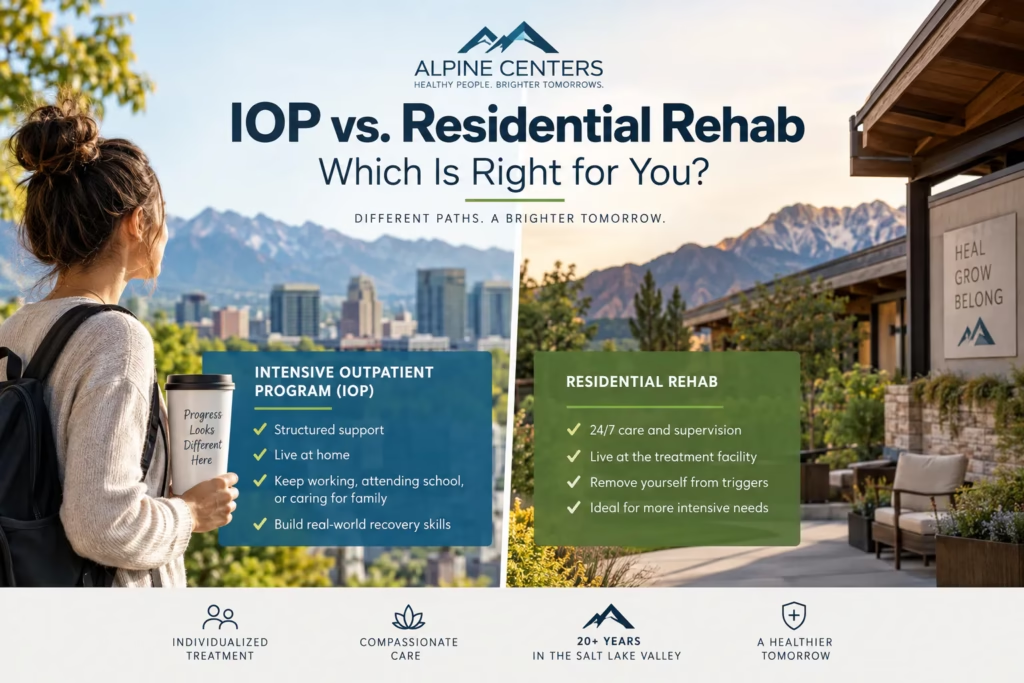
IOP vs. Residential Rehab in Salt Lake City: Which Level of Care Is Right for You?
If you’ve decided that drugs, alcohol, or your mental health are interfering with your life, making the decision to get help is important.
But that decision usually creates another question:
What kind of treatment do I actually need?
Do you need to leave home and enter a residential rehab program? Or could an Intensive Outpatient Program (IOP) provide enough structure and support while allowing you to continue working, attending school, caring for your family, and living at home?
There isn’t one answer that is right for everyone.
The appropriate level of care depends on your symptoms, substance use, withdrawal risk, mental health, home environment, previous treatment history, and ability to remain safe outside of treatment.
If you’re comparing addiction treatment options in Salt Lake City, understanding the difference between residential treatment and IOP is a good place to start.
What Is Residential Rehab?
Residential addiction treatment requires you to temporarily live at a treatment facility.
Instead of going to treatment for several hours and returning home, your living environment becomes part of the treatment setting. This creates a highly structured environment with significantly more supervision and separation from outside triggers.
Residential treatment may be appropriate when someone cannot safely or effectively manage their condition while continuing to live independently.
That can include situations involving severe or persistent substance use, an unsafe or highly unstable recovery environment, repeated relapse, serious psychiatric symptoms, or difficulty remaining safe and abstinent without continuous structure.
For some people, temporarily stepping away from everyday life is exactly what is needed.
For others, that level of restriction may not be necessary.
What Is an Intensive Outpatient Program?
An Intensive Outpatient Program, commonly called IOP, provides substantially more treatment and structure than traditional once-a-week therapy without requiring you to live at a treatment facility.
Patients typically attend treatment multiple days each week and return home afterward.
Depending on the program and the individual treatment plan, IOP may incorporate group therapy, individual therapy, relapse-prevention work, coping-skills development, family involvement, psychiatric services, medication management, and treatment for co-occurring mental health conditions.
That makes IOP an important middle ground.
You are receiving meaningful clinical structure and accountability, but you are also practicing recovery in the environment where you actually live.
For the right patient, that can be a significant advantage.
You aren’t learning how to manage triggers only inside a protected treatment environment. You’re learning skills in treatment and then applying them at home, at work, in relationships, and throughout your everyday life.
IOP vs. Residential Rehab: What’s the Biggest Difference?
The biggest difference is how much structure and supervision you need in order to remain safe and make meaningful progress.
Residential treatment provides an around-the-clock treatment environment.
IOP provides intensive clinical support while allowing you to maintain greater independence.
Neither is automatically “better.”
The better program is the one that provides the right amount of treatment for your current needs.
This is an important distinction because treatment that is not intensive enough can leave someone without adequate support. At the same time, someone who is stable enough for outpatient treatment may not need to completely step away from work, family, school, and other important parts of life.
A professional assessment helps determine where that balance should be.
You May Be a Good Candidate for IOP If…
IOP may be worth considering when you need considerably more support than occasional outpatient therapy but do not appear to require a 24-hour residential setting.
Common situations include:
You have a reasonably safe and stable place to live.
You are medically and psychiatrically stable enough to remain outside a 24-hour facility.
You need structured treatment several days each week.
You want to continue working, attending school, or caring for your family.
You are stepping down from residential or another higher level of care.
You have relapsed or are concerned about relapse and need greater accountability.
Substance use and mental health conditions are occurring together.
Weekly therapy has not provided enough support.
You can reliably attend treatment and participate in your recovery plan.
Being able to function in some areas of life does not necessarily mean that you don’t need treatment.
People can maintain jobs, relationships, homes, and responsibilities while still experiencing a serious substance use or mental health problem.
Treatment does not have to wait until everything falls apart.
When Might Residential or a Higher Level of Care Be More Appropriate?
There are situations where remaining at home may not provide enough safety or stability.
Someone experiencing severe withdrawal risk, significant medical complications, acute psychiatric instability, an unsafe living environment, inability to stop using despite intensive outpatient support, or other serious risks may need a higher level of care.
This is particularly important when alcohol, benzodiazepines, opioids, or multiple substances are involved.
Do not assume that stopping drugs or alcohol abruptly at home is always safe. Withdrawal from certain substances can become medically dangerous.
If there is concern about withdrawal, medical stabilization should be evaluated separately from the question of whether IOP will eventually be appropriate.
A person may need detoxification or another higher level of medical care first and then transition into an IOP once they are stable.
What If I’ve Already Been to Rehab Before?
Going through treatment before does not automatically mean that treatment “failed.”
It may mean that something in the previous treatment plan did not adequately address what was driving the problem.
Addiction rarely exists in isolation.
Anxiety, depression, trauma, relationship problems, chronic stress, psychiatric conditions, unstable environments, cravings, inadequate recovery support, and untreated medical needs can all affect someone’s ability to sustain progress.
This is one reason Alpine Centers focuses on looking at the entire clinical picture rather than simply asking whether someone is currently using drugs or alcohol.
If you’ve completed residential treatment previously, IOP can also be an important transition between a highly structured environment and completely independent recovery.
Going directly from 24-hour treatment to very little clinical support can be a dramatic change.
A structured outpatient program can provide continued accountability while you rebuild normal routines.
Can I Continue Working While Attending IOP?
For many people, yes.
This is one of the primary reasons people search for an Intensive Outpatient Program in Salt Lake City instead of residential treatment.
Adults seeking treatment frequently have careers, businesses, children, school, relationships, and financial obligations.
Taking several weeks away from those responsibilities may be extremely difficult or even impossible.
When clinically appropriate, IOP allows treatment to exist alongside the rest of your life instead of requiring you to completely leave it.
At Alpine Centers, treatment scheduling is designed to provide structured clinical care while giving patients the ability to maintain important responsibilities whenever possible.
The question, however, should not simply be, “Can I keep working?”
The more important question is:
Can I continue living independently while participating in treatment safely and successfully?
That is something your clinical assessment should help determine.
What If Addiction and Mental Health Problems Are Happening at the Same Time?
This is extremely important.
Someone seeking help for alcohol or drug use may also be struggling with depression, anxiety, trauma, ADHD, bipolar disorder, or another psychiatric condition.
Likewise, some people initially seek mental health treatment only to discover that substance use has become intertwined with their symptoms.
Treating one problem while ignoring the other can leave a major part of the clinical picture unresolved.
At Alpine Centers, addiction treatment can be coordinated with individual and group therapy, psychiatric medication management, and Medication-Assisted Treatment when clinically appropriate.
Having these services coordinated within one treatment system can reduce the fragmentation that occurs when your therapist, prescriber, and addiction-treatment provider are operating independently.
What About Medication-Assisted Treatment?
For certain substance use disorders, medication can be an important component of treatment.
Medication-Assisted Treatment, or MAT, combines appropriate medications with behavioral treatment and ongoing clinical support.
For patients with opioid use disorder, for example, medications such as buprenorphine may be considered as part of an individualized treatment plan.
Using medication in addiction treatment is not simply substituting one drug for another. When appropriately prescribed and monitored, medication can be one component of evidence-based treatment.
Alpine Centers provides medication support, including Suboxone and Sublocade when clinically appropriate, alongside behavioral and psychiatric services.
How Do Professionals Determine the Right Level of Care?
The decision should involve more than counting how frequently someone uses a substance.
Professional addiction-treatment assessments consider several areas of a person’s life and health.
That can include withdrawal and intoxication risk, physical health, psychiatric symptoms, substance-related risks, ability to function safely in the person’s current environment, available support, previous treatment history, and other factors.
The American Society of Addiction Medicine’s criteria are built around this broader approach to treatment planning.
That matters because two people using the same substance in similar quantities may need completely different treatment plans.
One may be appropriate for outpatient treatment.
Another may require medical stabilization or a 24-hour environment.
An assessment helps determine the difference.
Why Choose Alpine Centers for Outpatient Addiction Treatment in Salt Lake City?
Alpine Centers has served individuals and families in the Salt Lake Valley for more than 20 years.
Our approach is designed around a simple principle:
Treatment should match the person—not force the person into a predetermined program.
Alpine Centers provides coordinated outpatient behavioral health and medical services that can include Intensive Outpatient Treatment, individual therapy, group therapy, psychiatric medication management, Medication-Assisted Treatment, and treatment for co-occurring mental health conditions.
We are located in Taylorsville and serve patients throughout Salt Lake City, West Valley City, Murray, South Jordan, Draper, and surrounding Utah communities.
Alpine Centers is Joint Commission accredited and works with Medicaid and many major commercial insurance plans.
If you’re unsure whether you need IOP, traditional outpatient therapy, detoxification, residential treatment, or another level of care, you do not need to figure that out by yourself before calling.
That is what the assessment is for.
IOP vs. Residential Treatment: Start With the Right Question
People often begin by asking:
“Should I go to rehab?”
A better question is:
“What level of treatment gives me the best chance of getting better safely?”
Sometimes the answer is residential treatment.
Sometimes it’s Intensive Outpatient Treatment.
Sometimes it’s traditional outpatient therapy.
And treatment needs can change over time.
The important part is getting an accurate assessment and beginning at a level of care that matches what is actually happening in your life right now.
Looking for an Intensive Outpatient Program in Salt Lake City?
If you or someone you care about is struggling with addiction, relapse, substance use, or co-occurring mental health concerns, Alpine Centers can help you understand your options.
You can speak confidentially with our team, discuss what has been happening, verify your insurance benefits, and schedule an assessment to determine an appropriate next step.
You do not need to commit to treatment simply to ask questions.
Call Alpine Centers at 801-268-1715 to speak with our team or request an assessment.
Same-day and next-day appointments may be available.
Frequently Asked Questions
Is IOP the same as rehab?
IOP is a form of structured addiction or behavioral health treatment, but unlike residential rehab, patients do not live at the facility. They attend scheduled treatment sessions and return home.
How many days a week is IOP?
The exact schedule depends on the program and treatment plan. Alpine Centers’ IOP generally involves treatment multiple days each week, with the intensity adjusted according to clinical needs.
Can I live at home while attending an IOP?
Yes. Living at home is one of the defining characteristics of outpatient treatment. However, your home environment needs to be appropriate for outpatient care.
Does insurance cover IOP in Utah?
Many insurance plans provide benefits for medically necessary Intensive Outpatient Treatment, although coverage, deductibles, copays, authorization requirements, and network status vary. Alpine Centers can verify your individual benefits before treatment begins.
Do I have to complete residential treatment before entering IOP?
No. Some patients enter IOP directly, while others use it as a step-down after residential or another higher level of care. An assessment helps determine what is appropriate.
What if I don’t know what level of treatment I need?
You don’t have to know. A clinical assessment is designed to evaluate your symptoms, substance use, medical needs, mental health, environment, and other factors and recommend an appropriate level of care.
If you are in need of treatment contact us at 801-268-1715 or at Alpinecenters.com